
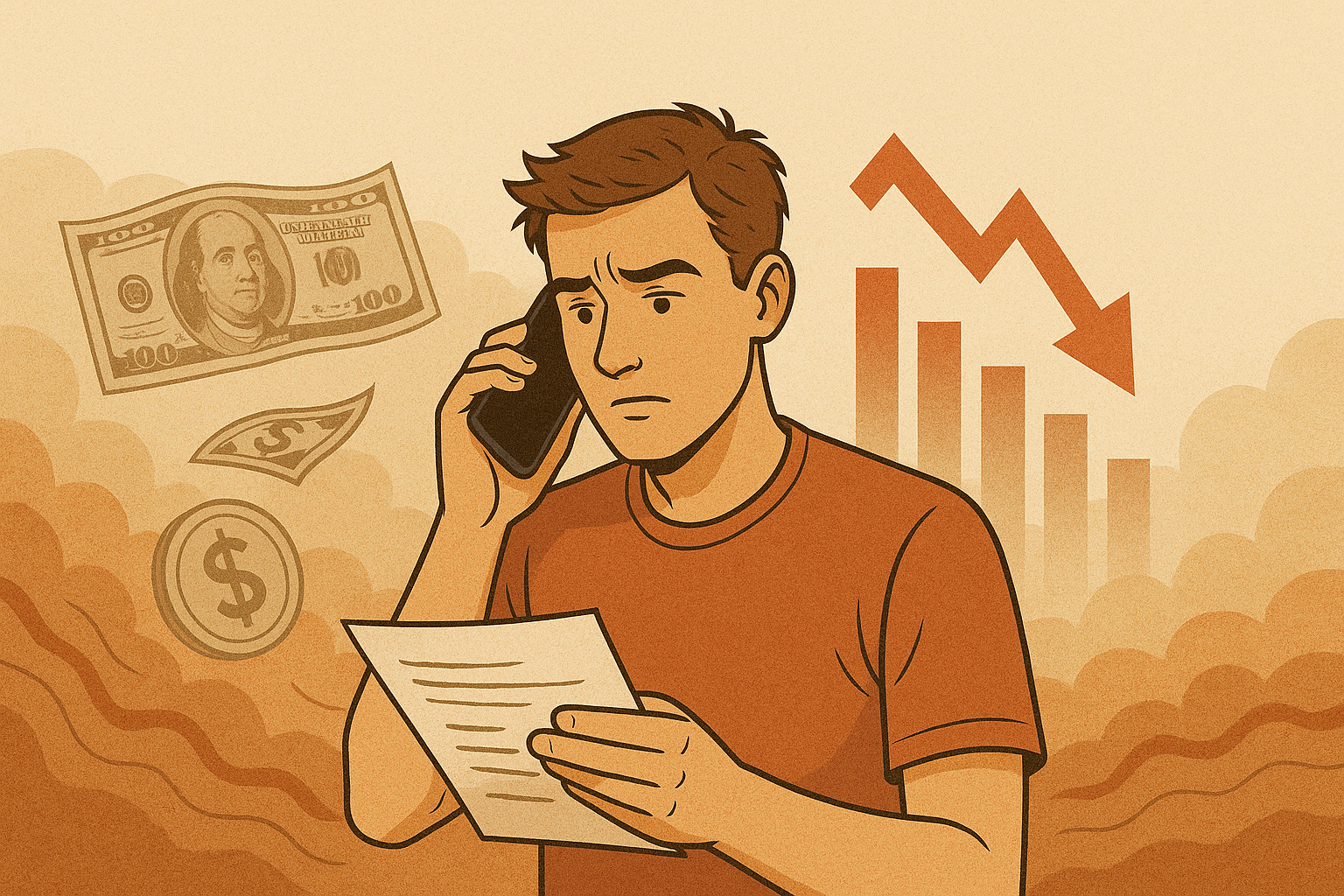

A few days ago, my phone lit up with a text from a friend: “Hey, can I call you tomorrow? I need advice on a financial decision and I am really stuck.”
Of course I said yes. But as soon as I hit send, I felt that familiar pressure — I wanted to give them real, solid guidance, not just platitudes. So I did what I always do when something matters: I started preparing.
What I didn’t realise was that this simple conversation prep would turn into a complete education on financial decision-making. Here’s the journey I went through, and the surprising things I learned along the way.
The Research Rabbit Hole Begins
That evening, I started where most people start: Google. But I didn’t want generic advice. I wanted to understand the why behind financial decisions, not just the what.
I found myself bouncing between behavioural economics papers, personal finance blogs, and videos from financial experts like Dave Ramsey. Each source led to another, and before I knew it, four hours had passed and my notebook was full of scribbled insights.
Here’s what emerged from that research session:
Takeaway #1: Your Bank Is Either Your Partner or Your Problem
The first thing that jumped out was how much your banking relationship actually matters. I would always thought a bank was just… a bank. Somewhere your money sits. Turns out, there is real science behind why some banking relationships create stress and others create peace.
When you don’t trust your financial institution — when you’re constantly locked out, stuck on hold, or dealing with unhelpful staff — it creates this background anxiety that researchers call “financial anxiety.” And here’s the kicker: that anxiety raises your cortisol levels, the same stress hormone that spikes when you are in actual danger.
The cognitive load connection: I found research showing that frustrating banking experiences drain your mental energy. Every time you have to fight with your bank, you’re using up the brain power you need for actual financial decisions. No wonder people with difficult banks seem to make more impulsive money choices—they are mentally exhausted.
What I realised: If your bank makes your life harder, you need to switch. It’s not about being picky; it’s about removing unnecessary stress from your financial life. Find a bank where you can actually talk to someone, where problems get solved quickly, where you feel like they are working with you.
Takeaway #2: The Cash-at-Home Paradox
This one was fascinating. I stumbled across research on the “availability heuristic”—basically, we feel more secure when we can physically see and touch our resources. That’s why so many people keep cash at home.
But here’s the paradox: large amounts of home cash are mostly an illusion of safety. Fire, theft, no insurance—the risks are real. Yet a small stash (like $500) can provide genuine peace of mind.
The placebo effect in action: If keeping some cash at home helps you sleep better at night, and it’s not creating real risk, there’s actual value in that psychological comfort. Sometimes our feelings matter more than perfect optimisation.
Digging Deeper: When Life Gets Messy
Around midnight, I shifted focus. My friend was going through a major life change, and I wanted to understand how that affects decision-making.
Takeaway #3: Your Brain Doesn’t Work Right When You’re Stressed
This is when I discovered something that should be taught in schools: stress literally shuts down the part of your brain responsible for long-term planning.
The prefrontal cortex—your brain’s executive function center—goes partially offline during major life transitions. Marriage, moving, job changes, family upheaval… your brain shifts into survival mode, not thriving mode.
The three-month rule: Research suggests it takes about 90 days for your brain to adapt to new circumstances and regain full cognitive function. This isn’t about being indecisive—it’s about waiting until your brain is actually capable of making good long-term decisions.
I wrote in my notebook: “Major financial decisions during major life changes = recipe for regret.”
Takeaway #4: Unclear Boundaries Destroy Relationships
As I kept reading, I found study after study showing the same thing: ambiguous expectations are the number one source of relationship conflict.
If you’re moving in with family, combining households with a partner, or entering any shared financial arrangement, you must have the uncomfortable conversations immediately.
Who pays for what? How long is this arrangement? What are the rules? It feels awkward on day one, but it’s nothing compared to the resentment that builds when nobody knows what’s expected.
The partnership principle: For couples especially, financial decisions require genuine equal input. Research from the Journal of Family and Economic Issues shows that money fights are among the strongest predictors of breakups. But couples who maintain unified financial decision-making—where both partners have real veto power—report being happier and less stressed.
I highlighted this in my notes: “Parents do not get a vote. Friends do not get a vote. Only your partner does.”
The Debt Deep-Dive (Where Things Got Real)
By 1 AM, I would moved into research on debt elimination. This is where everything clicked into place.
Takeaway #5: High Income Does Not Mean Wealth
I learned about “lifestyle inflation” and the “hedonic treadmill”—this psychological trap where we spend more as we earn more, ending up feeling just as broke as before.
The research on evolutionary psychology explained it: we are wired to compare ourselves to our peers, not to look at absolute prosperity. A doctor making $300,000 with $200,000 in debt can feel more financially stressed than a teacher making $60,000 debt-free.
The ratio matters more than the numbers. It is not about how much you make—it is about the gap between income and obligations, and how that gap makes you feel.
Takeaway #6: Debt Elimination Requires Temporary Extremes
Behavioural economists call it a “pre-commitment strategy”—deliberately limiting your choices to force yourself toward long-term goals. In plain English: if you want to eliminate debt fast, you have to live like you make way less than you actually do.
The math is simple but brutal: $200,000 in debt with $100,000 available annually for repayment = debt-free in two years. But that means living like you make $50,000 when you actually make $250,000.
The vengeance mindset: Here is where I found the most surprising research. Studies show that people who get emotionally intense about debt elimination—almost angry or vengeful—are significantly more likely to succeed.
Actually destroying credit cards, not just hiding them. Writing budgets by hand. Feeling the sacrifice of cutting restaurants and luxury purchases every single day. The research showed a 42% increase in follow-through when people made debt elimination an emotional crusade, not just a logical goal.
Takeaway #7: Tax Debt Is Different (and Dangerous)
This was a specific takeaway I had not expected: if you owe the IRS, that debt comes first. Always.
Unlike other creditors, tax authorities can garnish wages, seize assets, and place liens without court orders. The effective interest rate—combining penalties and interest—often hits 15-20%. From both a power perspective and a mathematical one, tax debt is your most dangerous debt.
Takeaway #8: The Two-Year Sweet Spot
Research on willpower and self-control revealed something practical: extreme restrictions become nearly impossible to maintain beyond 18-24 months, but shorter timelines often are not enough to change underlying habits.
Two years of focused intensity hits the sweet spot. It is hard but doable. And crucially, knowing there is an end date—that you are not signing up for permanent deprivation—makes it psychologically manageable.
The Health Connection (The Part That Hit Home)
Around 2 AM, I found research that made me sit back in my chair.
Takeaway #9: Financial Stress Literally Makes You Less Smart
A study published in the Proceedings of the National Academy of Sciences found that financial insecurity can temporarily lower your IQ by several points. The constant worry takes up so much mental bandwidth that you have less capacity left for everything else.
Financial stress activates the same neural pathways as physical threats. It raises stress hormones, disrupts sleep, damages health over time.
But the inverse is equally powerful: achieving financial stability—not wealth, just the absence of financial anxiety—produces measurable improvements in mental health, physical wellbeing, and relationship satisfaction.
This is why financial carelessness costs so much. It is not about money. It is about the mental energy, health, and peace that financial stress steals from every area of life.
Putting It All Together
By the time I closed my laptop at 2:30 AM, I had three clear principles:
Infrastructure: Get your banking and systems right. Choose partners that reduce friction, not create it.
Boundaries: Create clear rules, especially during transitions and in relationships. Have the hard conversations early.
Intensity: If you have debt, attack it with focused, temporary aggression. Make it emotional. Make it count.
The Conversation
The next day, when my friend and I talked, I shared what I had learned. Not as a lecture, but as a journey I had just taken myself.
We talked through their specific situation using these frameworks. Should they make this decision now or wait? Who needs to be involved? What’s the long-term impact versus the short-term pressure?
By the end of the call, they had clarity. But honestly? I think I got more out of preparing for that conversation than they did from having it.
What I AM Taking Forward
That friend’s question sent me down a rabbit hole that changed how I think about money. Not the technical details—I probably won’t remember the exact statistics in six months. But the principles are burned in:
You really cannot afford to be careless with money. Not because of the dollars and cents, but because financial stress poisons everything else in your life.
The good news? It’s fixable. Not easy, not quick, but absolutely doable with intentional action.
Sometimes the questions our friends ask lead us to the answers we needed ourselves. If you are facing a financial crossroads right now, maybe this journey can be useful for yours too.
The research is clear, the path is proven, and the peace of mind on the other side? Worth every uncomfortable step it takes to get there.

